

Walking is one of the simplest and most accessible forms of physical activity. You do not need an expensive gym membership, complicated equipment, or a large outdoor space to enjoy its benefits. With enough room to move safely, you can turn your home into a convenient place to improve cardiovascular fitness, support weight management, increase stamina, and maintain an active lifestyle.
However, one important question often comes up: Are you walking at the right pace?
When it comes to walking at home, speed matters, but it is not the only factor. Walking too slowly may not provide enough cardiovascular stimulation for your fitness goals, while walking too quickly without proper preparation can leave you exhausted or increase your risk of discomfort and injury.
The ideal walking pace depends on your age, current fitness level, health condition, exercise experience, and personal goals. Some people benefit from a comfortable walking rhythm, while others may need moderate or brisk walking to improve endurance.
Understanding how to measure your pace can help you make every indoor walking session more effective.
In this comprehensive guide, we will explore how to identify the right walking pace, measure your intensity, understand the benefits of indoor walking, and develop a sustainable routine that supports long-term health.
1. Why Walking at Home Is an Effective Way to Stay Active
Modern lifestyles often involve long hours of sitting, working on computers, watching television, and using smartphones. These habits can reduce everyday movement and make it difficult to achieve recommended physical activity levels.
Walking at home offers a practical solution.
Unlike outdoor walking, indoor walking does not depend on weather conditions, daylight, traffic, or nearby walking spaces. You can walk in your living room, hallway, balcony, or another safe open area.
Regular walking can support several aspects of physical health.
Supports cardiovascular health
Walking increases heart rate and encourages blood circulation. When performed regularly at an appropriate intensity, it helps improve cardiovascular fitness.
Helps maintain a healthy weight
Walking increases daily energy expenditure. Combined with balanced nutrition and other healthy habits, it can contribute to weight management.
Improves muscular endurance
Walking activates several muscle groups, including the calves, thighs, glutes, and muscles responsible for maintaining posture.
Supports mental well-being
Physical activity can improve mood, reduce everyday stress, and support emotional well-being.
Encourages consistency
One of the biggest advantages of walking at home is convenience. Even when you cannot go outside, you can maintain your activity routine.
The key is to find a walking pace that challenges your body without making the activity uncomfortable.
2. What Is the Right Walking Pace?
There is no single walking speed that works for everyone.
Your ideal pace should depend on how your body responds to movement. A healthy walking speed allows you to breathe more deeply, maintain a steady rhythm, and continue moving without experiencing excessive fatigue.
For many adults, moderate-intensity walking is a useful fitness target.
A practical guide to different walking intensities is shown below.
| Walking intensity | Approximate pace | How it feels |
|---|---|---|
| Slow walking | Below 3 km/h | Very comfortable |
| Easy walking | 3–4 km/h | Relaxed conversation |
| Moderate walking | 4–5.5 km/h | Breathing faster but comfortable |
| Brisk walking | 5.5–6.5 km/h | More challenging |
| Very fast walking | Above 6.5 km/h | Difficult to maintain for many people |
These speeds are approximate outdoor-style walking equivalents. Indoor walking pace can be harder to measure because people may take shorter steps, turn frequently, or walk in place.
Your personal fitness level matters more than matching a particular number.
For beginners, a comfortable pace is an excellent starting point. As endurance improves, walking speed and duration can gradually increase.
3. The Talk Test: One of the Easiest Ways to Measure Walking Pace
You do not need a smartwatch or fitness tracker to determine whether you are walking at an appropriate intensity.
One of the simplest methods is the talk test.
The talk test measures exercise intensity by observing how easily you can speak while walking.
Light-intensity walking
- You can speak comfortably without changing your breathing.
- Your heart rate increases only slightly.
- You feel relaxed and can continue for a long time.
Moderate-intensity walking
- You breathe faster than usual.
- You can talk in complete sentences.
- Singing becomes difficult.
- You feel that your body is working, but you are not exhausted.
Vigorous-intensity walking
- Your breathing becomes considerably faster.
- You can speak only a few words before needing another breath.
- Maintaining the same speed becomes challenging.
For many generally healthy adults, moderate-intensity walking is an excellent everyday fitness target.
If you are new to exercise, start with light-intensity walking and gradually progress.
The talk test is particularly useful for indoor walking because it does not require distance measurements or specialized equipment.
4. How to Measure Your Walking Speed at Home
Although the talk test is convenient, measuring your walking speed can help you understand your progress more clearly.
Here are several simple methods.
Method 1: Use a Stopwatch
Choose a safe, measured walking route inside your home.
For example, if you have a hallway or a defined walking space, measure its length and record how many times you walk across it.
You can then calculate your approximate distance and speed.
The formula is:
Walking speed = Distance ÷ Time
For example:
- Distance covered: 200 metres
- Time taken: 4 minutes
- Walking speed: 50 metres per minute
Converting this to kilometres per hour gives approximately 3 km/h.
Remember that frequent turns and changes in direction can influence your results.
Method 2: Use a Fitness Tracker
Smartwatches and fitness bands can estimate:
- Walking duration
- Step count
- Heart rate
- Estimated distance
- Calories burned
- Daily activity levels
These measurements can help you understand your activity patterns.
However, indoor distance and calorie estimates are not always accurate. Treat them as approximate indicators rather than exact measurements.
Method 3: Count Your Steps
Step counting is another practical way to monitor indoor walking.
You can use a smartphone or wearable device to record your steps.
Instead of focusing only on reaching a specific daily number, pay attention to your personal baseline.
For example, if you usually complete 3,000 steps daily, you might gradually increase your activity by adding 500 steps when your body comfortably adapts.
There is no universal requirement to reach 10,000 steps every day. Your health, lifestyle, and fitness level should guide your target.
Method 4: Monitor Your Heart Rate
Your heart rate provides another indication of exercise intensity.
A higher walking intensity generally produces a higher heart rate, although the response varies depending on age, fitness, medications, temperature, and health conditions.
You can use a smartwatch or manually check your pulse.
Avoid relying on a single heart-rate number to determine your ideal pace. If you take medication that affects heart rate or have a cardiovascular condition, ask your healthcare professional about appropriate exercise intensity.
5. Signs That You Are Walking at the Right Pace
Sometimes the easiest way to evaluate your walking routine is to observe how your body feels.
Here are several signs that your walking pace may be appropriate.
Your breathing becomes slightly faster
During moderate walking, your breathing should increase naturally. However, you should still be able to speak comfortably.
You feel physically active but not exhausted
A good walking session should make you feel that you have exercised without leaving you completely drained.
Your movements remain controlled
Your steps should feel natural and coordinated. You should not need to take uncomfortable strides or force your body to maintain speed.
You can maintain the pace consistently
If you can walk at a particular speed for several minutes without excessive fatigue, it may be appropriate for your current fitness level.
You recover comfortably
Your breathing should gradually return toward normal after you slow down or stop.
If you regularly experience dizziness, unusual breathlessness, chest discomfort, or faintness, stop exercising and seek appropriate medical advice. Severe or persistent chest pain, fainting, or significant breathing difficulty requires urgent medical attention.
6. What Happens When You Walk Too Slowly?
Slow walking is not necessarily ineffective.
In fact, slow walking can be valuable for beginners, older adults, people recovering from periods of inactivity, and anyone who needs a gentle movement routine.
It can help:
- Reduce prolonged sitting.
- Encourage daily movement.
- Improve movement confidence.
- Support mobility.
- Provide a gentle warm-up.
- Help establish an exercise habit.
However, if your primary goal is improving cardiovascular endurance, exclusively slow walking may not provide enough intensity as your fitness improves.
The solution is not to eliminate slow walking.
Instead, combine different walking intensities.
For example, you might start with five minutes of comfortable walking, continue with ten minutes of moderate walking, and finish with five minutes of slower movement.
This approach provides variety while allowing your body to adapt.
7. What Happens When You Walk Too Fast?
Walking faster can increase exercise intensity, but faster is not always better.
If you suddenly increase your walking speed, your muscles, joints, and cardiovascular system may struggle to adapt.
Potential problems include:
- Excessive fatigue.
- Muscle soreness.
- Poor walking posture.
- Discomfort in the knees or ankles.
- Loss of balance.
- Difficulty maintaining proper breathing.
Indoor walking can also involve frequent turns, which require additional attention to balance and coordination.
If you notice that your steps become uncontrolled or your breathing becomes excessively uncomfortable, reduce your speed.
A sustainable walking routine should challenge you without forcing your body beyond its current capacity.
8. How Long Should You Walk at Home Every Day?
The appropriate walking duration depends on your fitness level and exercise goals.
For generally healthy adults, public health guidelines recommend at least 150 minutes of moderate-intensity aerobic activity per week, or 75 minutes of vigorous-intensity activity, or an equivalent combination.
Muscle-strengthening activities involving major muscle groups are also recommended at least twice weekly.
You do not need to complete all your walking in one session.
You can divide your activity into smaller periods throughout the day.
For example:
| Session | Walking duration |
|---|---|
| Morning | 10 minutes |
| Afternoon | 10 minutes |
| Evening | 15 minutes |
| Daily total | 35 minutes |
This approach can make physical activity easier to fit into a busy schedule.
If you are currently inactive, start with shorter sessions and gradually increase your walking duration.
Consistency is more important than attempting an ambitious routine immediately.
9. A Beginner-Friendly Indoor Walking Routine
If you have not exercised regularly, begin with a simple routine that focuses on comfortable movement.
20-minute beginner walking routine
Warm-up
5 minutes
Walk slowly, relax your shoulders, and gradually increase your movement.
Main walking session
10 minutes
Maintain a comfortable pace. If possible, gradually move toward moderate intensity.
Cool-down
5 minutes
Slow down gradually and allow your breathing to settle.
Repeat this routine according to your recovery and comfort.
Once 20 minutes feels manageable, you can gradually increase your walking duration or introduce short intervals of faster walking.
10. Interval Walking: A Simple Way to Improve Your Pace
Interval walking involves alternating between different walking intensities.
It is a practical way to introduce variety without maintaining a fast pace throughout the entire workout.
For example:
- Walk comfortably for two minutes.
- Walk briskly for one minute.
- Return to a comfortable pace for two minutes.
- Repeat the sequence.
You can start with just one or two brisk intervals.
As your fitness improves, you may gradually increase the number of intervals.
Interval walking can help improve cardiovascular endurance while making indoor exercise more engaging.
However, beginners should first establish a comfortable walking routine before introducing challenging intervals.
11. How to Improve Your Walking Speed Safely
Improving walking speed takes time.
Instead of trying to walk significantly faster in one session, focus on small improvements.
Increase Your Walking Duration First
Before increasing speed, make sure you can comfortably maintain your current walking duration.
For example, if you can walk for ten minutes, gradually work toward fifteen or twenty minutes.
Improve Your Walking Technique
Good walking technique supports comfort and movement efficiency.
Pay attention to:
- Keeping your head upright.
- Looking forward instead of constantly looking down.
- Relaxing your shoulders.
- Bending your elbows naturally.
- Taking comfortable steps.
- Allowing your arms to swing naturally.
Avoid exaggerating your stride length.
Introduce Short Brisk Intervals
Once you can walk comfortably for longer periods, add short intervals of faster walking.
This helps your body gradually adapt to increased intensity.
Maintain Consistency
Walking three or more times per week can help establish a regular exercise habit.
Your exact schedule should reflect your recovery, fitness level, and personal circumstances.
Wear Comfortable Footwear
Choose supportive shoes with sufficient grip and cushioning.
Avoid walking quickly on slippery floors or in footwear that makes your movements unstable.
12. Walking at Home for Weight Management
Walking at home can contribute to weight management by increasing daily energy expenditure.
However, weight changes depend on several factors, including:
- Food intake.
- Overall physical activity.
- Sleep quality.
- Muscle mass.
- Individual metabolism.
- Consistency over time.
Walking alone does not guarantee weight loss.
For better long-term results, combine regular walking with balanced nutrition, adequate protein, sufficient sleep, and strength training.
You can also increase everyday movement by:
- Walking while listening to podcasts.
- Taking short movement breaks.
- Walking during television advertisements.
- Moving around after long periods of sitting.
- Adding short indoor walking sessions after meals.
These small changes can help reduce sedentary time.
13. Is Walking After Meals Beneficial?
A short walk after eating can be a useful way to incorporate more movement into your day.
Research suggests that light physical activity after meals can help reduce post-meal blood glucose elevations.
For many people, a gentle walk of approximately 10–15 minutes after a meal is a practical starting point.
However, you should consider your comfort.
Avoid immediately starting an intense walking session after a large meal, particularly if it causes digestive discomfort.
People managing diabetes or other medical conditions should follow their healthcare professional’s advice regarding exercise and blood glucose monitoring.
14. Walking at Home for Older Adults
Walking can be an important part of maintaining mobility and independence as people age.
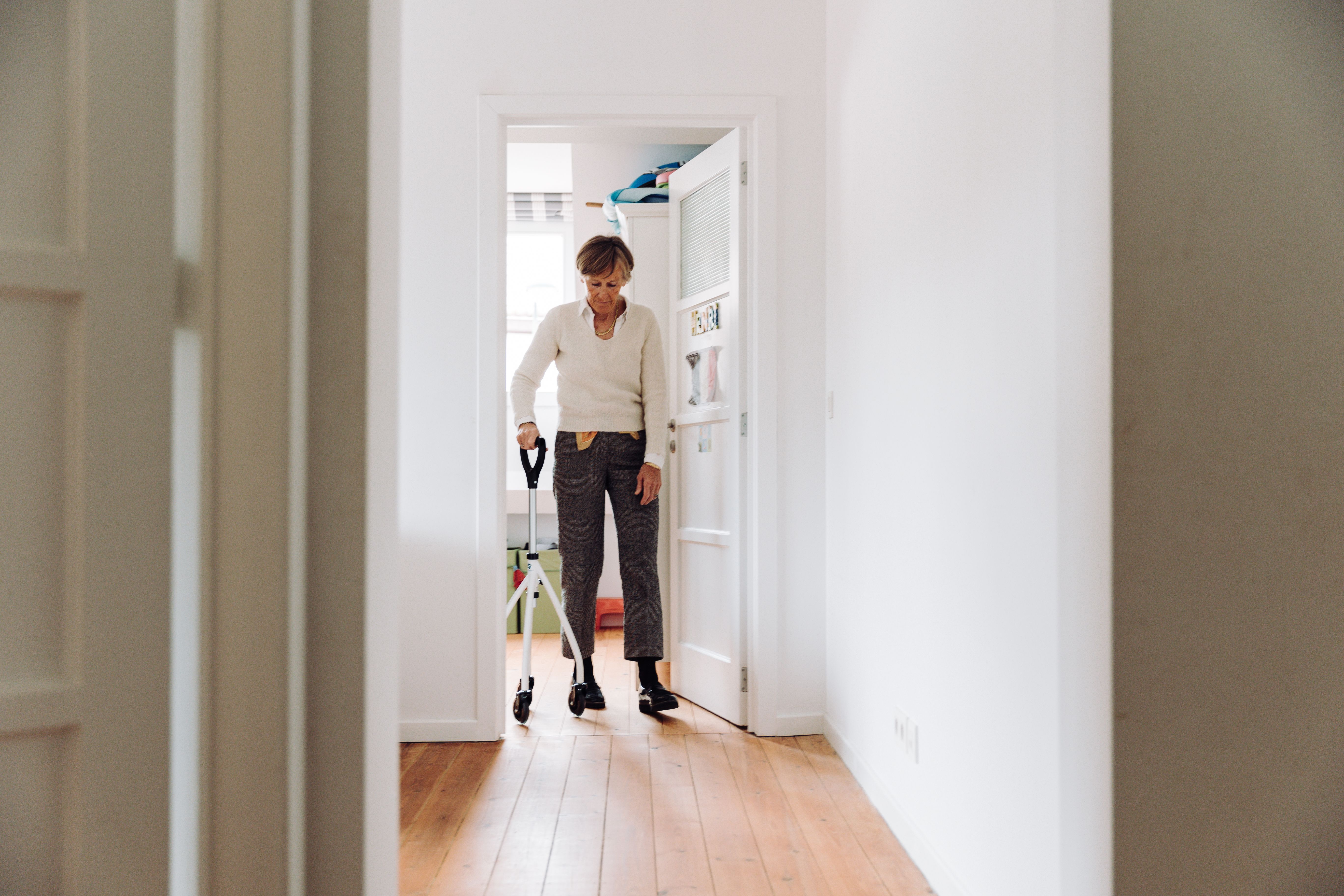
However, older adults may need to pay particular attention to balance, joint comfort, and walking surfaces.
A suitable indoor walking routine can support:
- Everyday mobility.
- Lower-body endurance.
- Movement confidence.
- Cardiovascular fitness.
- General physical activity.
Safety should always come first.
Consider these precautions:
- Remove loose rugs and obstacles.
- Walk on a dry, nonslip surface.
- Ensure the room has adequate lighting.
- Wear comfortable, supportive footwear.
- Keep a stable support nearby if balance is a concern.
- Begin with shorter walking sessions.
- Increase duration and pace gradually.
Older adults with balance difficulties or mobility limitations may benefit from guidance from a physiotherapist or healthcare professional.
15. Common Mistakes to Avoid While Walking at Home
Even a simple exercise can become less effective when performed incorrectly.
Here are some common mistakes to avoid.
Walking too fast at the beginning
Starting at maximum speed can cause unnecessary fatigue. Begin with a warm-up and increase intensity gradually.
Ignoring posture
Looking down continuously or leaning excessively forward can create discomfort. Maintain a natural, upright posture.
Taking excessively long steps
Longer steps do not automatically mean faster or better walking. Use a comfortable stride.
Walking on slippery surfaces
Indoor walking should always be performed in a safe, uncluttered space.
Ignoring pain
Mild muscular effort is normal, but persistent or sharp pain should not be ignored.
Focusing only on step count
Step count is useful, but walking intensity, duration, consistency, and overall health are equally important.
Skipping recovery
Your body needs adequate rest, particularly when you are increasing exercise intensity.
You’re not alone in thinking about this. Check out this reddit thread of people discussing the same.
16. How to Make Indoor Walking More Interesting
One challenge of walking at home is maintaining motivation.
Without changing scenery, indoor walking can sometimes feel repetitive.
Fortunately, a few simple adjustments can make it more enjoyable.
Listen to music
Create a playlist with songs that match your preferred walking rhythm.
Watch educational videos
Use your walking time to listen to informative content or watch something enjoyable.
Try walking workouts
Follow beginner-friendly indoor walking routines that include simple movements.
Track your progress
Record your walking duration, steps, and perceived effort.
Set realistic goals
Instead of focusing on dramatic changes, aim to improve one small aspect of your routine each week.
Walk with family members
Walking together can make exercise more enjoyable and encourage consistency.
The best walking routine is one that you can realistically maintain.
17. How to Know Whether Your Fitness Is Improving
Improvement does not always mean walking faster.
Your fitness may be improving in several ways.
Look for these changes:
- You can walk longer without becoming tired.
- Your breathing feels more controlled.
- Your recovery becomes quicker.
- You can maintain a steady rhythm.
- Everyday activities feel easier.
- You feel more comfortable moving regularly.
Keep a simple weekly record.
| Fitness indicator | What to monitor |
|---|---|
| Duration | Total minutes walked |
| Steps | Average daily steps |
| Intensity | Easy, moderate, or vigorous |
| Recovery | How quickly breathing settles |
| Comfort | Muscle and joint response |
| Consistency | Number of walking sessions |
Review your progress every two to four weeks.
This will help you identify improvements without becoming overly focused on daily fluctuations.
18. Walking Pace and Heart Health
Walking is a valuable form of aerobic activity.
When you walk at moderate intensity, your heart works harder to deliver oxygen-rich blood to working muscles.
Over time, regular aerobic activity can improve cardiovascular fitness and support overall heart health.
However, the appropriate intensity varies between individuals.
A person who regularly exercises may comfortably walk at a brisk pace, while someone who has been inactive may achieve moderate intensity at a slower speed.
This is why heart-rate readings should be interpreted alongside your symptoms, fitness level, and perceived effort.
If you have heart disease, uncontrolled blood pressure, or another medical condition that affects exercise tolerance, seek professional advice before beginning a challenging walking programme.
19. The Importance of Breathing While Walking
Breathing is an important part of maintaining a comfortable walking rhythm.
When walking, allow your breathing to become naturally deeper as your intensity increases.
Avoid unnecessarily holding your breath.
A few useful tips include:
- Maintain relaxed breathing.
- Avoid excessive tension in your shoulders.
- Slow down if breathing becomes uncomfortable.
- Use the talk test to monitor intensity.
- Allow your breathing to settle during cool-down.
You do not need to follow a complicated breathing pattern.
Comfortable, natural breathing is generally sufficient during ordinary walking.
20. Walking at Home and Mental Well-Being
Physical activity does not only benefit the body. It can also support mental well-being.
Regular walking may help improve mood, reduce stress, and provide a refreshing break from work or screen time.
For people working from home, short walking breaks can also help interrupt long periods of sitting.
Consider adding a five-minute walking break between work sessions.
You can use this time to move away from your desk, relax your mind, and return to your responsibilities with a fresh perspective.
Walking is not a replacement for professional mental healthcare, but it can be a useful part of a balanced wellness routine.
21. A Seven-Day Walking at Home Plan
If you want to establish a regular indoor walking habit, begin with a manageable seven-day schedule.
The following plan is designed as a general example for beginners who can walk safely. Adjust the duration according to your fitness and recovery.
| Day | Activity | Duration |
|---|---|---|
| Monday | Comfortable walking | 15 minutes |
| Tuesday | Moderate walking | 20 minutes |
| Wednesday | Easy walking | 15 minutes |
| Thursday | Walking intervals | 20 minutes |
| Friday | Moderate walking | 20 minutes |
| Saturday | Comfortable walking | 25 minutes |
| Sunday | Gentle walking or rest | 10–15 minutes |
Start slowly and take additional rest when needed.
You do not have to complete every session exactly as written.
If you are already active, you may need a more challenging routine. If you are new to exercise, begin with shorter sessions.
The goal is to build a sustainable habit rather than force rapid progress.
22. How to Combine Walking With Other Exercises
Walking is beneficial, but combining it with other forms of physical activity can create a more balanced fitness routine.
Consider adding:
Strength training
Exercises such as squats, wall push-ups, resistance-band rows, and modified lunges can help strengthen major muscle groups.
Mobility exercises
Gentle ankle circles, shoulder movements, and hip mobility exercises can support comfortable movement.
Balance training
Simple balance exercises can help improve stability, particularly for older adults.
Stretching
Gentle stretching after exercise can help maintain flexibility and movement comfort.
A balanced weekly routine should include aerobic activity, muscle strengthening, and exercises that support balance and mobility where appropriate.
23. How Much Walking Is Enough for Long-Term Health?
There is no universal step count that guarantees good health.
The commonly discussed 10,000-step goal can be motivating, but it is not a mandatory target for everyone.
Research indicates that meaningful health benefits can occur at lower step counts, particularly when people increase activity from a sedentary baseline.
Rather than comparing your progress with someone else’s, focus on improving your personal activity level.
For example:
- If you currently walk 2,000 steps, work toward 2,500.
- If you comfortably complete 5,000 steps, gradually increase your daily movement.
- If you are already highly active, focus on maintaining consistency and including different forms of exercise.
Small improvements can contribute to better long-term activity habits.
24. Who Should Be Careful With Indoor Walking?
Walking is generally safe for many people, but certain situations require additional care.
People with the following concerns should consider medical guidance before increasing walking intensity:
- Significant joint pain.
- Recent surgery or injury.
- Balance problems.
- Uncontrolled blood pressure.
- Heart or lung conditions.
- Severe dizziness.
- Unexplained breathlessness.
Pregnant individuals with uncomplicated pregnancies can often benefit from walking, but exercise recommendations should reflect their individual circumstances.
Stop exercising if you experience chest pain, faintness, unusual shortness of breath, or severe discomfort.
Do not attempt to push through warning symptoms simply to complete a step target.
25. The Best Strategy for Finding Your Personal Walking Pace
Finding your ideal walking pace does not require complicated calculations.
Start by understanding your current fitness level.
Then follow a few simple principles:
Step 1: Begin comfortably
Walk at an easy pace for five minutes.
Step 2: Gradually increase your speed
Move slightly faster until your breathing becomes deeper but remains comfortable.
Step 3: Apply the talk test
If you can speak in complete sentences but cannot comfortably sing, you are likely working at moderate intensity.
Step 4: Maintain a consistent rhythm
Avoid constantly changing your speed without a reason.
Step 5: Monitor your recovery
After slowing down, notice how quickly your breathing returns toward normal.
Step 6: Adjust according to your goals
If you want to improve endurance, gradually increase walking duration. If your current fitness allows it, add short brisk intervals.
Step 7: Stay consistent
Repeat your routine regularly and make gradual adjustments.
Remember that the right walking pace is not necessarily the fastest pace you can achieve. It is the pace that supports your goals while allowing you to exercise safely and consistently.
Frequently Asked Questions (FAQs)
1. What is the best walking speed at home?
For many adults, a moderate walking speed of approximately 4–5.5 km/h can be a useful reference. However, the appropriate speed depends on fitness level, age, health, and walking technique.
2. How do I know if I am walking fast enough?
Use the talk test. During moderate-intensity walking, you should breathe faster than usual but still be able to speak in complete sentences.
3. Is walking at home as effective as outdoor walking?
Yes. Indoor walking can provide similar aerobic benefits when duration and intensity are comparable. Outdoor walking may offer additional variety and environmental stimulation.
4. How many minutes should I walk at home daily?
Many adults can work toward 20–30 minutes of walking on most days. However, shorter sessions are also beneficial, especially for beginners.
5. Can walking at home help reduce belly fat?
Walking increases energy expenditure and can support overall weight management. However, it cannot specifically target belly fat. Balanced nutrition, regular activity, strength training, and adequate sleep are important.
6. Is walking slowly better than walking fast?
Both have benefits. Slow walking is useful for beginners, warm-ups, and recovery, while moderate and brisk walking can provide greater cardiovascular stimulation.
7. Can I walk at home after dinner?
Yes. A gentle 10–15-minute walk after dinner can be a practical way to increase movement and may help reduce post-meal blood glucose elevations.
8. Should I walk every day?
Many people can walk daily if they adjust intensity and duration according to recovery. However, rest or lighter activity may be appropriate when tired or uncomfortable.
9. Can beginners start with 10 minutes of walking?
Absolutely. Ten minutes is a reasonable starting point for many beginners. Gradually increase the duration as your fitness improves.
10. Is a smartwatch necessary for tracking walking pace?
No. A stopwatch, measured walking route, and talk test can help you estimate your walking intensity without a smartwatch.
Conclusion: Move at a Pace That Supports Your Health
Walking at home is a practical way to improve daily movement, support cardiovascular fitness, maintain muscular endurance, and build healthier lifestyle habits.
However, the real value of walking does not come from speed alone.
It comes from finding an appropriate pace, maintaining good technique, gradually improving endurance, and staying consistent.
For many generally healthy adults, moderate-intensity walking is an excellent target. The talk test offers a simple way to identify this intensity without needing expensive equipment.
Start with a comfortable pace, listen to your body, and increase your activity gradually.
Whether you walk for ten minutes or thirty minutes, every safe movement session can contribute to a more active lifestyle.
The best walking pace is the one that challenges you appropriately, fits your current fitness level, and helps you keep moving consistently.
Do you like this personality?