


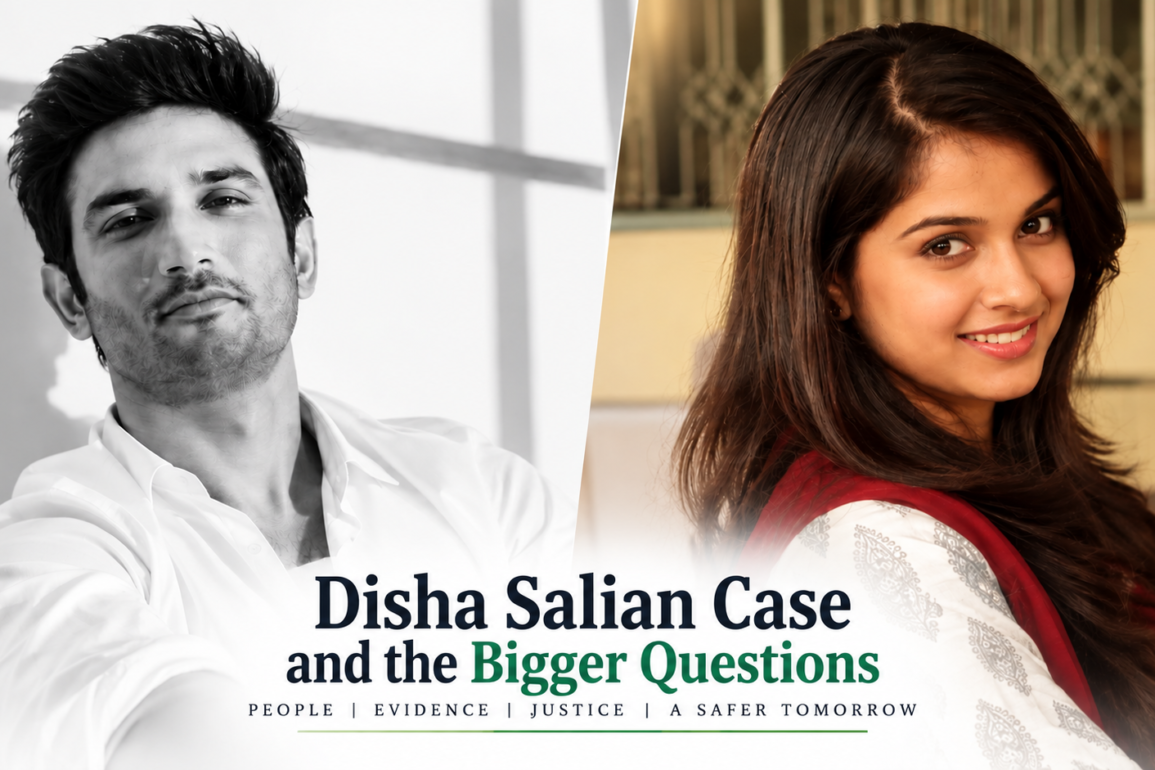
By HealthcareBiodiversity News Desk
Updated: September 17, 2026
The death of celebrity manager Disha Salian has entered a new legal phase after the Bombay High Court directed the Central Bureau of Investigation (CBI) to conduct a fresh investigation into the circumstances surrounding her death in June 2020.
The CBI subsequently registered an FIR on September 13, 2026. The FIR contains allegations relating to murder, gang rape, destruction or disappearance of evidence, criminal conspiracy and alleged misconduct in the earlier investigation. Importantly, the CBI has not named anyone as an accused at this stage; the names appearing in the complaint/FIR are persons whose alleged roles are to be examined.
The case has also remained publicly linked with the death of actor Sushant Singh Rajput, who died six days after Salian.
This article brings together the current legal developments, statements attributed to advocate Nilesh Ojha, the allegations made by Disha’s father Satish Salian, the publicly circulated “13 deaths” theory, and an illustrative reconstruction prepared for this article.
1. Who Was Disha Salian?

Disha Salian was a celebrity manager who worked in the entertainment industry and had worked with Sushant Singh Rajput.
She died on June 8, 2020, after falling from a high-rise residential building in Mumbai.
The initial police inquiry was conducted as an Accidental Death Report (ADR) rather than as an FIR alleging a cognisable offence.
Mumbai Police subsequently concluded that the death was a suicide.
Her death became the subject of continuing public discussion, particularly because Sushant Singh Rajput died approximately six days later, on June 14, 2020.
2. Why Did the Case Return to Court?
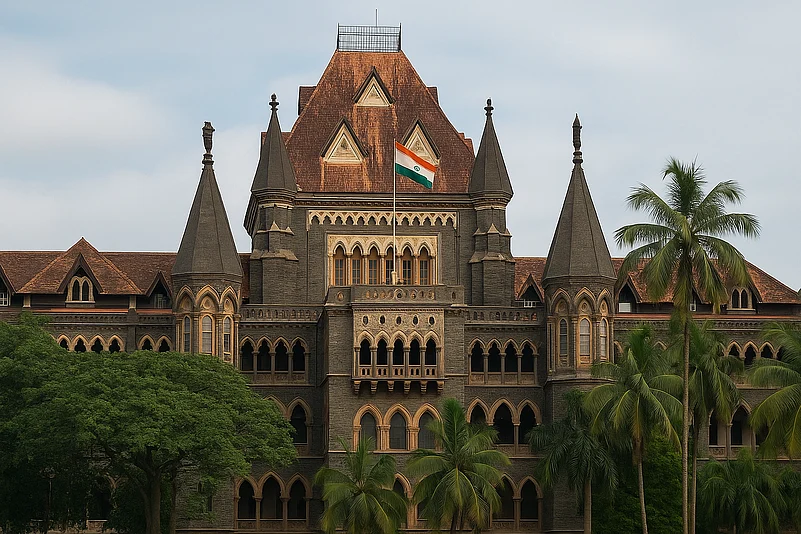
Disha’s father, Satish Salian, subsequently approached the Bombay High Court seeking a fresh investigation.
His petition alleged that Disha had been raped and murdered and that there had been a subsequent attempt to cover up the alleged crime.
His lawyer, Nilesh Ojha, raised several questions about the earlier police investigation.
On September 2, 2026, the Bombay High Court directed the CBI to investigate the circumstances surrounding Disha’s death and directed the agency to register an FIR.
The court said that the earlier investigation had been inadequate in the circumstances of the case and that a different investigating agency was required.
However, the court also imposed an important legal safeguard:
No person should be treated as an accused unless the investigating officer finds sufficient material giving rise to reasonable suspicion.
Therefore, the High Court’s decision to order a CBI investigation does not constitute a finding that anyone committed a crime.
3. What Has Advocate Nilesh Ojha Alleged?
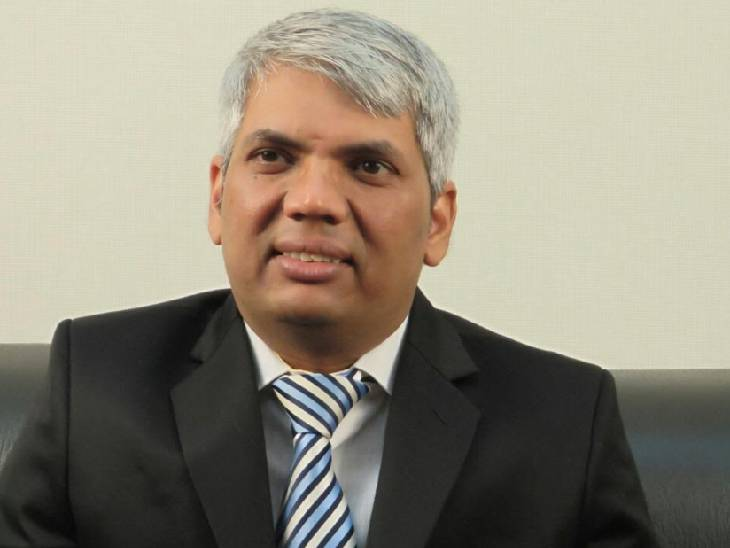
Advocate Nilesh Ojha represents Disha’s father.
In the proceedings and subsequent public statements, Ojha has raised questions about several aspects of the original investigation.
Among the issues reported in connection with his arguments are:
- the decision to conduct an accidental-death inquiry;
- the timing and documentation of the scene;
- the scene panchnama;
- the post-mortem examination;
- photographs of the body;
- alleged inconsistencies in forensic material;
- handling of Disha’s mobile phone;
- digital evidence;
- witness statements; and
- the possibility that evidence connected with the case was not properly investigated.
These are allegations and investigative questions, not findings that have already been proved in court.
The High Court’s decision to order a fresh CBI investigation means these issues can now be examined by investigators using the original records and physical and digital evidence.
4. What Does the New CBI FIR Contain?
https://drive.google.com/file/d/1z6K6Ee9bIscd9YPBZpwNEF15Y56z7QkR/view?usp=sharing
The CBI registered the FIR on September 13, 2026, following the High Court’s direction and after recording Satish Salian’s statement.
Reports state that the FIR invokes provisions concerning allegations including:
- gang rape;
- murder;
- destruction or disappearance of evidence;
- criminal conspiracy; and
- alleged misconduct or incorrect recording of official information by public servants.
The FIR is based substantially on the complaint and statement of Disha’s father.
The CBI is now expected to examine the original police records, witnesses, forensic material and other evidence.
5. Names Mentioned in the CBI FIR
According to reporting on the FIR, the document mentions several people whose alleged roles are to be investigated.
The reported names include:
Political figures and public officials
- Aaditya Thackeray
- Uddhav Thackeray
- Anil Deshmukh
- Param Bir Singh
- Sachin Vaze
- DCP Vishal Thakur
Entertainment-industry names
- Rhea Chakraborty
- Showik Chakraborty
- Dino Morea
- Sooraj Pancholi
- Rohan Roy
The FIR also reportedly refers to bodyguards, police personnel, forensic officials, doctors and other individuals whose roles may need examination.
Important legal clarification
The presence of a person’s name in a complaint or FIR does not establish guilt.
The CBI is currently investigating the allegations and determining whether there is evidence against any individual.
This distinction is particularly important because the Bombay High Court expressly stated that no person should be treated as an accused unless sufficient material emerges during the investigation.
6. Responses From People Mentioned
The renewed investigation has also prompted responses from people whose names have appeared in public reporting.
For example, Aaditya Thackeray has denied knowing Disha Salian and has described the allegations linking him to the case as an attack on his reputation.
Actor Sooraj Pancholi has also publicly denied having a connection with Disha Salian and said he would cooperate with investigators if required.
These responses are relevant because the investigation involves competing claims that have yet to be resolved through evidence.
7. The Reported Mobile-Phone Questions
One of the issues raised in connection with the case concerns Disha Salian’s mobile phone.
Reports about the FIR say that the complaint raises questions about the timing of the phone’s seizure and subsequent activity involving the device.
The allegation is that the device and its digital information require closer examination to establish:
- who possessed the phone;
- when it was seized;
- whether it was accessed after seizure;
- what data remained on the device;
- whether any data was deleted or altered; and
- whether the phone contains evidence relevant to the events surrounding Disha’s death.
These are matters for forensic and investigative verification.
A claim concerning a mobile phone should not be treated as evidence of criminal conduct unless investigators establish what actually happened to the device.
Swab vs Smear: A Key Forensic Record Discrepancy
One of the specific issues examined in the Bombay High Court proceedings concerns the description of biological samples collected during Disha Salian’s post-mortem examination.
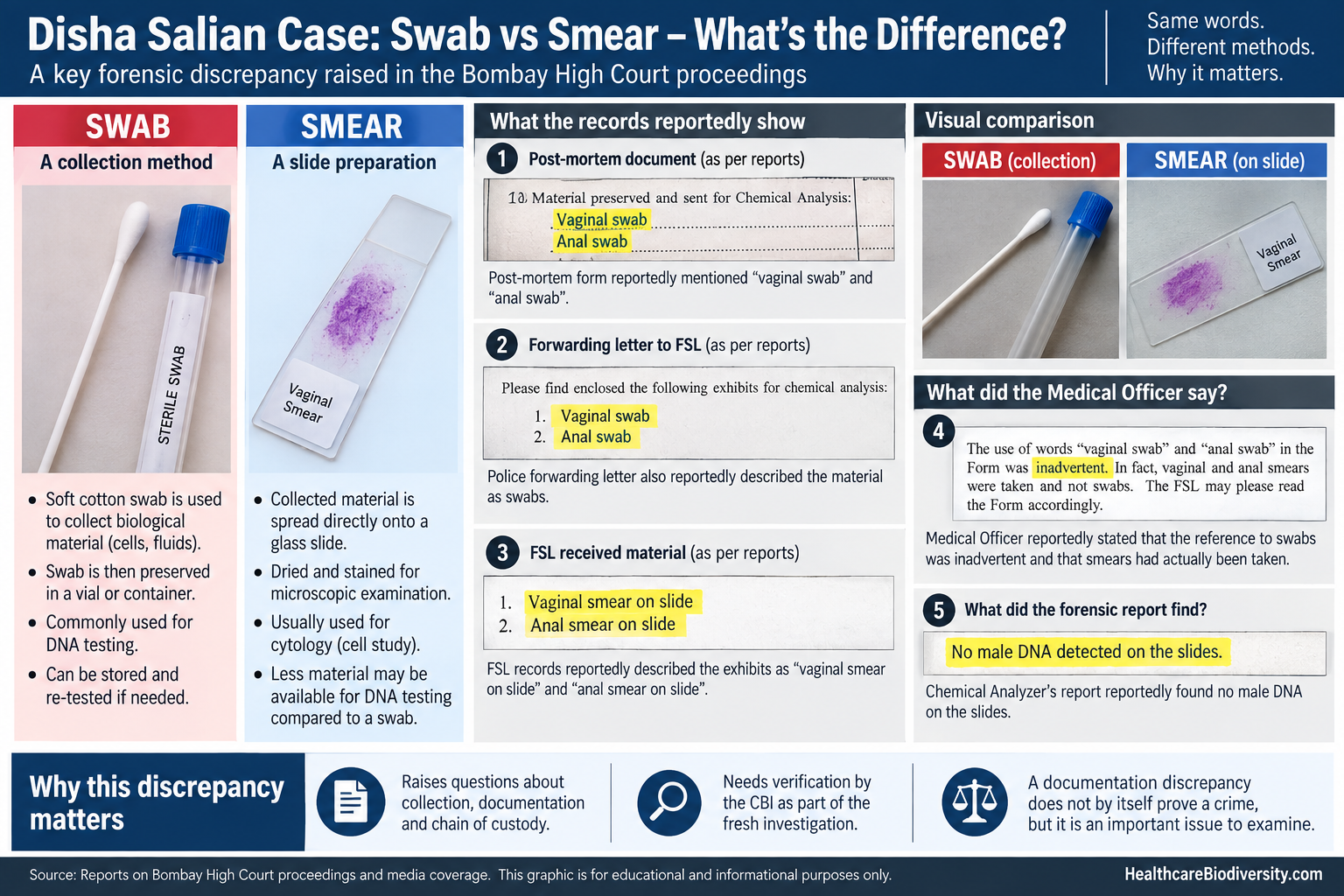
According to the records discussed by the court, the post-mortem documentation referred to vaginal and anal swabs being taken for examination. A communication to the Forensic Science Laboratory (FSL) also reportedly described the material as vaginal and anal swabs.
However, when the exhibits were examined by the FSL, the material was described as “vaginal smear on slide” and “anal smear on slide.” The FSL subsequently sought clarification about the difference between the description in the medical records and the material actually received.
What is the difference between a swab and a smear?
A swab generally refers to a collection method in which biological material is collected using a swab. Depending on the protocol, the collected material can subsequently be preserved or processed for laboratory examination.
A smear, in this context, refers to biological material that has been transferred onto a microscope slide for examination.
The distinction matters because the investigation concerns the identity, collection, preservation and examination of biological evidence. However, the terminology alone does not establish that evidence was tampered with or that a crime occurred.
What did the Medical Officer say?
According to the material discussed in the High Court proceedings, the Medical Officer subsequently responded that the vaginal and anal swabs had not actually been taken and that vaginal and anal smears had been taken instead.
The response reportedly stated that the earlier reference to “vaginal swab” and “anal swab” in the form was inadvertent, and that the FSL should read the entries as referring to vaginal and anal smears.
This explanation is now one of the records that can be examined by the CBI.
What did the forensic report find?
The Chemical Analyzer’s report reportedly stated that no male DNA was detected on the slides.
That finding is important to report accurately, but it should not be interpreted by itself as proof either of sexual assault or of the absence of sexual assault.
The evidentiary significance depends on questions such as:
- what material was actually collected;
- when and how it was collected;
- how it was preserved;
- when it reached the laboratory;
- whether the samples were sufficient for testing;
- what testing was performed;
- what DNA could reasonably have been detected; and
- whether the chain of custody was properly maintained.
Why has the discrepancy become important?
Advocate Nilesh Ojha has argued that the difference between the original references to “swab” and the later description of “smear on slide” requires investigation.
The High Court also identified this discrepancy among the issues requiring consideration when it ordered the CBI investigation.
At the same time, there is an important distinction between a documentation discrepancy and proof of evidence manipulation.
The former is documented in the court-recorded material; the latter remains an allegation that investigators would need to establish through evidence.
What should the CBI establish?
The CBI can potentially examine the complete chain of documentation, including:
- The original post-mortem form.
- Form II and other medical records.
- The doctor’s original notes.
- The police forwarding letter.
- The FSL’s receipt and examination records.
- The actual slides/exhibits, if preserved.
- The FSL correspondence seeking clarification.
- The Medical Officer’s subsequent explanation.
- The Chemical Analyzer’s report.
- The chain of custody of the biological material.
This may help determine whether the difference was simply a documentation error, a difference in terminology or procedure, or whether there is evidence of a more serious irregularity.
Why we are mentioning this
The swab-versus-smear issue should not be presented as proof that Disha Salian was sexually assaulted or murdered.
Instead, it is one of the specific forensic-record discrepancies that has been raised in the case and identified in reporting on the High Court proceedings.
The CBI’s fresh investigation provides an opportunity to examine the original medical and forensic records and determine what actually happened.
8. Questions About the Post-Mortem and Forensic Evidence
Another major issue raised publicly concerns the post-mortem examination.
Ojha and Disha’s family have questioned whether certain injuries and photographs are consistent with the circumstances described in the earlier investigation.
Reports have also discussed forensic observations concerning injuries visible or allegedly absent in photographs.
These observations have been presented as reasons for further examination.
However, a photograph alone cannot determine the cause or manner of death.
A proper forensic assessment would need to consider:
- the original post-mortem report;
- histopathology where available;
- toxicology;
- photographs;
- injury patterns;
- height of the fall;
- landing surface;
- building geometry;
- clothing;
- scene evidence;
- witness accounts; and
- other physical and digital evidence.
The CBI investigation can now examine these materials together rather than relying on isolated photographs or statements.
9. The Sushant Singh Rajput Connection
Disha Salian’s death became closely associated with the Sushant Singh Rajput case because Rajput died approximately six days later.
Sushant Singh Rajput was found dead at his Bandra residence on June 14, 2020.
The timing resulted in widespread speculation that the two deaths were connected.
However, the fact that two people died within six days does not, by itself, establish a criminal connection.
The current CBI investigation into Disha’s death may examine whether any reliable evidence connects the two cases.
That connection must be established through evidence rather than chronology alone.
10. The “13 Deaths” Theory
Another subject repeatedly discussed online is a claim sometimes described as the “13 deaths” theory surrounding the wider Sushant Singh Rajput controversy.
An online article circulating in September 2026 presents a list of people and attributes the theory to discussions involving lawyer Nilesh Ojha, former police officer Sachin Vaze and an online group identifying itself as SSR Warriors. Importantly, the source itself distinguishes the theory from facts established by investigators or courts.
The names circulated in that discussion are:
- Manmeet Grewal
- Sachin Kumar
- Preksha Mehta
- Krish Kapoor
- Disha Salian
- Agnes Lisa Smith
- Sushant Singh Rajput
- Maya
- Anandi Dhawan
- Sameer Bangara
- Steve Pinto
- Anupama Pathak
- Sameer Sharma
Important qualification
HealthcareBiodiversity is not presenting these 13 deaths as a confirmed group or as evidence of a common conspiracy.
The list is being included because it has been circulated in public discussions surrounding the Sushant Singh Rajput and Disha Salian cases.
The available source does not establish that these deaths were caused by the same person, organisation or criminal conspiracy.
11. Why a List of Deaths Does Not Establish a Connection
A chronological list can raise questions, but it cannot by itself establish a criminal relationship.
For every individual in such a list, investigators would need to establish:
- the person’s identity;
- the officially recorded cause of death;
- the date and circumstances of death;
- the person’s actual relationship with Disha or Sushant;
- relevant communications;
- financial or professional relationships, if any;
- geographic connections;
- witness evidence;
- forensic evidence; and
- any evidence connecting one death to another.
Without this evidence, the existence of multiple deaths in the same period should not be described as proof of a conspiracy.
This distinction is particularly important when discussing public figures and allegations of serious crimes.
12. Why the “13 Deaths” Discussion Has Continued
The theory continues to circulate because the Sushant Singh Rajput case generated enormous public attention and because Disha Salian died shortly before Rajput.
Online discussions have attempted to connect different people through:
- professional relationships;
- entertainment-industry connections;
- media reports;
- political connections;
- social relationships; and
- the timing of deaths.
Some of these relationships may be documented, while others are based on online claims.
The role of a criminal investigation is to determine which relationships have evidentiary significance.
13. Our Illustrative Reconstruction of the Building
For this article, HealthcareBiodiversity has also prepared an illustrative reconstruction using a photograph of the residential building.
The purpose is to help readers understand the physical geometry involved in a hypothetical fall.
The illustration shows two hypothetical trajectories:
Near trajectory
A hypothetical path resulting in a landing zone relatively close to the building.
Far trajectory
A hypothetical path showing a landing zone farther from the building.
The illustration is intended to demonstrate how the horizontal distance travelled can differ depending on the circumstances at the point of departure.
What Determines a Fall Trajectory?
In physics, the horizontal distance travelled during a fall can be affected by several variables.
These include:
- height;
- initial horizontal velocity;
- direction of movement;
- body position;
- point of departure;
- surrounding structures;
- wind;
- landing surface; and
- interaction with balconies or other building features.
Consequently, simply looking at a photograph of a building cannot establish the exact trajectory of a person.
14. The Reconstruction Is Not a Forensic Finding
The graphic prepared for this article is not a professional forensic reconstruction.
It is an educational illustration based on the visible building geometry.
It does not use:
- an official 3D survey;
- verified measurements from the original scene;
- complete CCTV footage;
- verified coordinates;
- autopsy measurements;
- validated trajectory calculations; or
- the complete forensic case file.
Therefore, neither the near nor the far trajectory shown in the graphic should be interpreted as what actually happened.
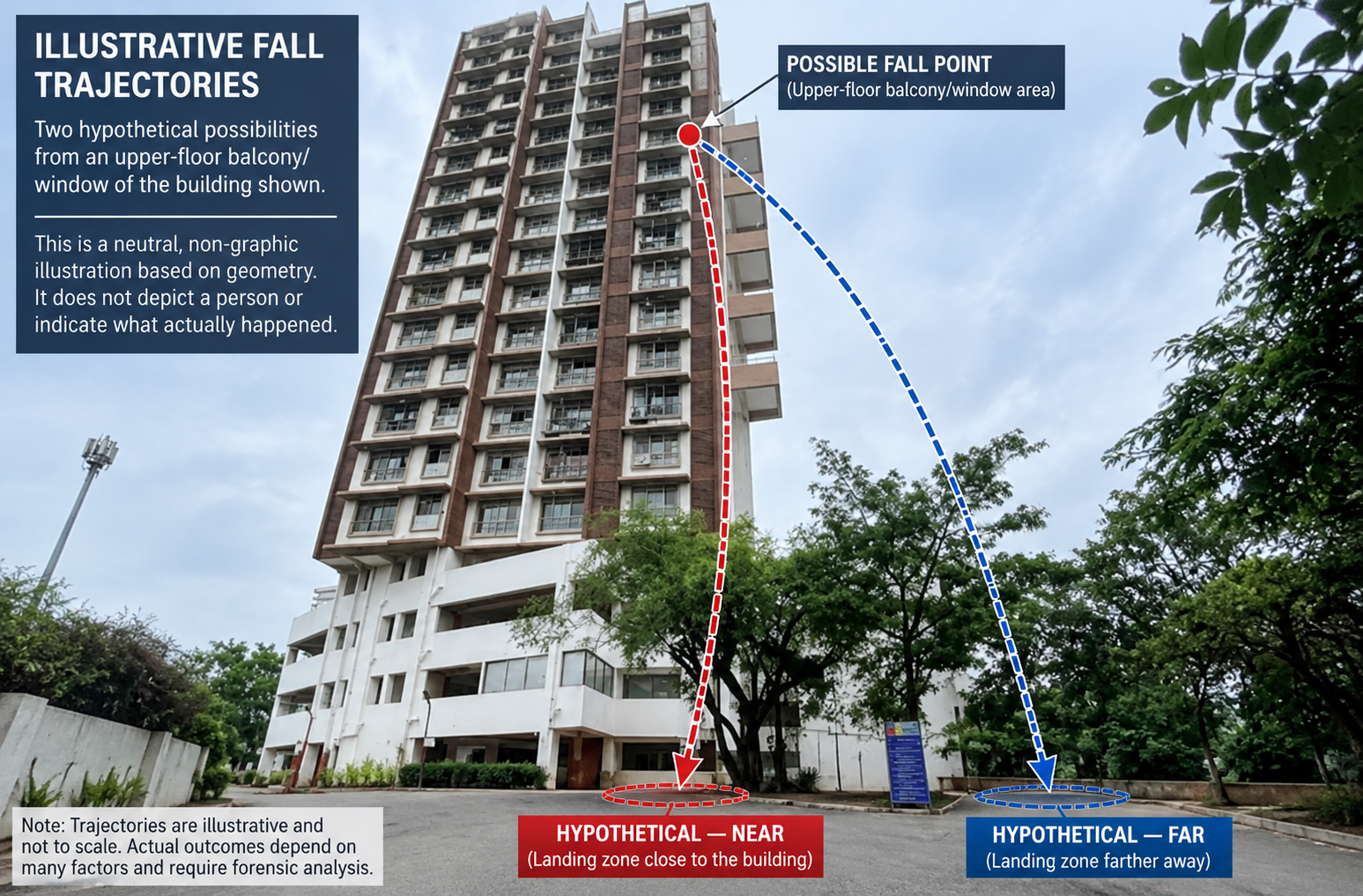
Illustrative reconstruction showing hypothetical near and far fall trajectories from an upper-floor area of the residential building. The trajectories are for educational visualization only and do not establish the actual path, landing point or manner of death.
15. Why We Have Included the Reconstruction
The physical setting is an important part of understanding any investigation involving a fall from a high-rise building.
A visual reconstruction can help readers understand questions concerning:
- the building’s height;
- the surrounding open area;
- possible landing zones;
- the relationship between the building and nearby structures; and
- why precise measurements would be necessary for a genuine forensic reconstruction.
It should therefore be regarded as an educational visual aid, not as evidence establishing one particular theory.
16. What the CBI Can Now Examine
Current reporting indicates that investigators are expected to examine several categories of evidence, including:
Police records
The CBI can review the original police inquiry, statements and documentation.
Scene evidence
Investigators can examine the location and compare it with the original photographs and records.
Witnesses
People who were present at or around the building can be questioned again where necessary.
Forensic evidence
The agency can review the post-mortem, forensic reports, photographs and related material.
Digital evidence
Phones, communications, CCTV and other digital records can potentially be examined.
Earlier investigation
The CBI can examine how the original investigation was conducted and whether the records support the conclusions reached at the time.
These areas are consistent with current reporting about the investigation.
17. What the Bombay High Court Actually Decided
It is important not to misinterpret the High Court’s order.
The court did not determine that:
- Disha Salian was murdered;
- a rape occurred;
- a particular politician was responsible;
- Sushant Singh Rajput’s death was connected to Disha’s death; or
- the “13 deaths” theory was true.
Instead, the court concluded that the earlier investigation raised sufficient concerns to justify a fresh CBI investigation.
The court also directed that if the CBI finds no offence, it can submit a closure report.
18. What Happens Next?
The CBI investigation is now the principal investigative process concerning the allegations raised in the new FIR.
Investigators can:
- examine the original case records;
- record witness statements;
- examine forensic evidence;
- examine digital evidence;
- inspect the scene;
- question relevant individuals;
- verify allegations contained in the complaint; and
- determine whether sufficient evidence exists to proceed against anyone.
The outcome will depend on the evidence collected during the investigation.
19. Facts, Allegations and Online Claims: Keeping Them Separate
For readers following this case, three categories should be kept separate.
Established procedural facts
The Bombay High Court ordered a CBI investigation.
The CBI registered an FIR on September 13, 2026.
The FIR is based on allegations made by Disha’s father.
The investigation is ongoing.
Allegations
Claims of rape, murder, conspiracy, evidence suppression and other wrongdoing have been made by Disha’s father and his legal representatives.
These allegations are being investigated.
Online theories
The “13 deaths” theory and other internet discussions contain claims about possible relationships between individuals and events.
Those claims should not be treated as established facts without independent evidence.
20. Conclusion
The Disha Salian case has entered a significant new investigative stage more than six years after her death.
The Bombay High Court’s September 2026 order directed the CBI to conduct a fresh investigation after finding shortcomings in the earlier handling of the matter. The CBI subsequently registered an FIR based on the complaint and statement of Disha’s father, Satish Salian.
Advocate Nilesh Ojha has raised questions about the original investigation, including issues concerning scene documentation, forensic material, post-mortem evidence, digital records and Disha’s mobile phone.
The FIR also mentions several individuals whose alleged roles are now subject to investigation.
Separately, the wider public discussion surrounding Sushant Singh Rajput has produced theories such as the so-called “13 deaths” theory. The names circulated in that theory have been included in this article for completeness, but their inclusion does not establish that the deaths were connected or that a criminal conspiracy existed.
The illustrative fall-trajectory image prepared for this article should similarly be understood only as an educational visualization. It is not a forensic determination of what happened.
Ultimately, the most important development is the evidence gathered by the CBI.
The investigation will have to determine what happened to Disha Salian, whether any criminal offence occurred, whether any evidence was mishandled, and whether there is any demonstrable evidentiary connection between her death and other events discussed publicly.
Until those questions are answered through evidence and the legal process, allegations should remain clearly identified as allegations.
Editorial Disclaimer
HealthcareBiodiversity publishes this article for informational and public-interest purposes. The article distinguishes between court-recorded developments, reported statements, allegations, online theories and independently established facts. Inclusion of a person’s name in an FIR, complaint, interview, video or online theory does not establish guilt or criminal involvement. All allegations remain subject to investigation and due legal process.
The “13 deaths” list is reproduced only as a description of an online theory reported in publicly available material; it is not presented as an official CBI list or as proof of a common criminal connection.
The fall-trajectory graphic is an original illustrative reconstruction prepared for this article. It is hypothetical, not to scale, and should not be interpreted as a forensic reconstruction or as a depiction of the actual incident.