


Building a stronger core is one of the most important goals for anyone who wants to improve fitness, develop better posture, and perform everyday activities with greater confidence. Although many people associate core training with achieving visible abdominal muscles, the core serves a much broader purpose. It stabilizes the spine, supports the pelvis, transfers force between the upper and lower body, and helps maintain balance during movement.
Whether you are a beginner starting your gym journey, an experienced lifter looking to improve performance, or someone who wants to develop a more balanced fitness routine, effective core training can make a meaningful difference.
Your core muscles work during almost every physical activity. When you squat, deadlift, run, jump, carry groceries, or simply stand upright, these muscles help control your body’s position and movement. A stronger core can improve your ability to maintain proper technique during strength training and help you perform exercises more efficiently.
However, developing core strength requires more than performing hundreds of crunches. The most effective approach combines exercises that challenge stability, resist unwanted movement, control rotation, and strengthen the muscles surrounding the trunk and hips.
In this guide, you will discover how to build a stronger core through effective gym exercises, proper training techniques, progressive overload, recovery strategies, and practical workout routines. You will also learn how to avoid common mistakes and create a sustainable core workout plan that supports your overall fitness goals.
1. Understanding the Core Muscles
Before selecting the best exercises, it is important to understand what the core actually includes.
The core is a group of muscles that work together to stabilize and control the trunk and pelvis. These muscles extend beyond the visible abdominal muscles and contribute to posture, movement, and force production.
Rectus Abdominis
The rectus abdominis is the long muscle running vertically along the front of the abdomen. It is commonly associated with the appearance of a six-pack.
Its primary functions include flexing the trunk and helping control pelvic position. Exercises such as crunches, reverse crunches, and controlled hanging knee raises target this muscle.
Transverse Abdominis
The transverse abdominis is a deep abdominal muscle that wraps around the trunk like a natural belt. It contributes to abdominal tension and trunk stability.
Learning to brace the abdominal muscles can help you maintain a stable torso during heavy lifts and challenging core exercises.
Internal and External Obliques
The obliques run along the sides of the abdomen. They contribute to trunk rotation, side bending, and resistance to unwanted rotation.
Exercises such as side planks, cable chops, and controlled rotational movements can develop these muscles.
Erector Spinae
The erector spinae muscles run along the spine and help extend and stabilize the back. They play an important role in maintaining posture and controlling trunk movement during exercises such as deadlifts.
Multifidus and Other Deep Stabilizers
The multifidus and other smaller stabilizing muscles help control movement between the vertebrae and contribute to spinal stability.
Although these muscles may not be highly visible, their role in coordinated trunk movement is important.
Glutes and Hip Muscles
The gluteal muscles and surrounding hip muscles also contribute to core function. They help stabilize the pelvis and support movements such as squats, lunges, and single-leg exercises.
The key takeaway: A stronger core involves developing the muscles around your trunk and pelvis as a coordinated system rather than focusing exclusively on the front of your abdomen.
2. Benefits of Building a Stronger Core
Consistent core training can improve several aspects of physical performance and general fitness.
Improved Posture and Trunk Control
Your core muscles help maintain a stable torso when sitting, standing, lifting, and moving. Developing core strength can improve your ability to control your posture during these activities.
However, good posture also depends on movement habits, mobility, ergonomics, and individual anatomy. Core exercises are one useful part of the overall picture.
Better Strength Training Performance
A stable trunk helps transfer force between the upper and lower body. During squats and deadlifts, for example, your abdominal and back muscles work together to control the position of your torso.
A stronger core may help you maintain technique as resistance increases. Nevertheless, strength improvements depend on the entire training program, including exercise selection, technique, recovery, and appropriate progression.
Improved Balance and Coordination
Core exercises challenge your ability to control the trunk while your arms and legs move. This is especially useful during unilateral exercises, loaded carries, and movements performed on one leg.
Better trunk control can support coordination during gym workouts and everyday activities.
Greater Athletic Performance
Running, jumping, throwing, and changing direction require coordination between the trunk and limbs. Core strength and control contribute to the efficient transfer of force during these movements.
Athletes may benefit from exercises that challenge anti-rotation, trunk stiffness, and dynamic control.
Support for Everyday Activities
Lifting objects, carrying bags, climbing stairs, and getting up from the floor all require coordinated movement of the trunk and hips.
A stronger core can help you control these tasks, especially when core training is combined with full-body strength exercises.
A More Balanced Physique
Core training can develop the abdominal muscles, obliques, and supporting muscles of the trunk. When combined with appropriate nutrition and full-body resistance training, it can contribute to a more balanced physique.
Visible abdominal definition, however, also depends on body-fat levels, genetics, muscle development, and individual fat distribution.
3. The 15 Best Gym Exercises for a Stronger Core
The best core workout includes different types of movement. Instead of repeating one exercise, combine movements that challenge the trunk in several ways.
The following exercises can be adapted to different fitness levels.
Exercise 1: Plank
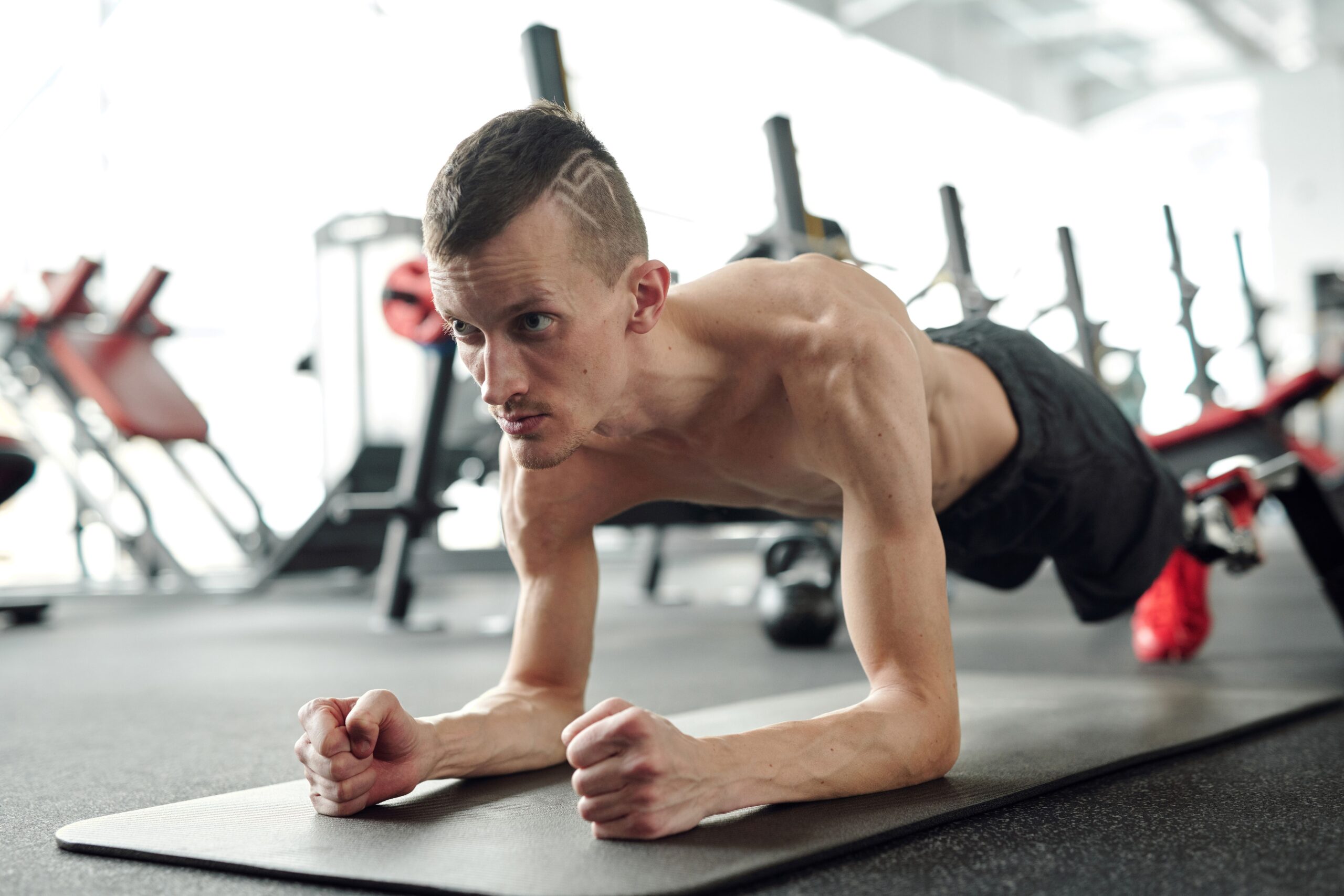
The plank is one of the most accessible exercises for developing core endurance and trunk stability.
It challenges the abdominal muscles, shoulders, and other stabilizing muscles while requiring you to maintain a controlled body position.
How to perform it:
- Begin with your forearms and toes on the floor.
- Keep your elbows approximately beneath your shoulders.
- Extend your legs and create a straight line from your head to your heels.
- Tighten your abdominal muscles and glutes.
- Breathe normally while maintaining the position.
- Stop when you can no longer maintain proper alignment.
Recommended sets: 3
Recommended duration: 20–45 seconds per set.
Common mistake: Allowing the lower back to sag or lifting the hips excessively.
Beginners can perform the plank with their knees on the floor. More advanced trainees can use a longer lever or add resistance when appropriate.
Exercise 2: Side Plank
The side plank targets the obliques and challenges your ability to resist side bending.
It is particularly useful for developing lateral trunk stability.
How to perform it:
- Lie on one side with your elbow beneath your shoulder.
- Stack your feet or place one foot in front of the other.
- Lift your hips until your body forms a straight line.
- Keep your shoulders and hips aligned.
- Hold the position while breathing steadily.
- Lower your hips under control and switch sides.
Recommended sets: 2–3 per side
Recommended duration: 15–40 seconds.
Beginners can bend their knees and support themselves on their forearm and lower leg.
Exercise 3: Cable Crunch
Cable crunches allow you to train abdominal flexion with adjustable resistance.
Unlike endless bodyweight repetitions, the cable machine makes it easier to increase resistance gradually.
How to perform it:
- Attach a rope to a high cable pulley.
- Kneel in front of the machine and hold the rope near your head.
- Keep your hips relatively stable.
- Curl your rib cage toward your pelvis.
- Pause briefly while contracting your abdominal muscles.
- Return slowly to the starting position.
Recommended sets: 3
Recommended repetitions: 10–15.
Common mistake: Pulling primarily with the arms or using the hips to create momentum.
Choose a weight that allows controlled movement without straining your neck or lower back.
Exercise 4: Hanging Knee Raise
Hanging knee raises challenge the abdominal muscles and require control of the pelvis.
They also train grip and shoulder stability.
How to perform it:
- Hang from a pull-up bar using a comfortable grip.
- Keep your shoulders controlled rather than passively shrugging.
- Brace your abdomen.
- Lift your knees toward your torso without swinging.
- Curl your pelvis upward slightly at the top.
- Lower your legs slowly.
Recommended sets: 3
Recommended repetitions: 8–12.
If hanging is difficult, use a captain’s chair or perform reverse crunches on a mat.
Avoid swinging your body to complete repetitions.
Exercise 5: Dead Bug
The dead bug is an excellent exercise for learning to coordinate breathing, abdominal bracing, and limb movement.
It is especially useful for beginners because the difficulty can be adjusted without heavy equipment.
How to perform it:
- Lie on your back with your arms extended toward the ceiling.
- Raise your legs with your hips and knees bent approximately 90 degrees.
- Gently brace your abdomen.
- Slowly lower one arm and the opposite leg.
- Keep your lower back controlled against the floor.
- Return to the starting position and switch sides.
Recommended sets: 3
Recommended repetitions: 8–12 per side.
Move slowly and reduce the range of motion if your lower back begins to arch excessively.
Exercise 6: Pallof Press
The Pallof press is an anti-rotation exercise that trains the core to resist rotational forces.
It can be useful for athletes, recreational lifters, and anyone seeking improved trunk control.
How to perform it:
- Set a cable pulley around chest height.
- Stand sideways to the machine and hold the handle at your chest.
- Step away until you feel light tension.
- Brace your abdomen and keep your hips facing forward.
- Press your hands straight in front of your chest.
- Resist the cable’s attempt to rotate your torso.
- Return the handle slowly and repeat.
Recommended sets: 3
Recommended repetitions: 8–12 per side.
Avoid using so much weight that your shoulders or hips twist to compensate.
Exercise 7: Ab Wheel Rollout
Ab wheel rollouts are a challenging exercise that trains the abdominal muscles to resist excessive spinal extension.
They require good control and are best introduced after you can perform simpler core exercises comfortably.
How to perform it:
- Kneel on a mat with the wheel beneath your shoulders.
- Grip the handles firmly.
- Brace your abdomen and squeeze your glutes.
- Roll forward slowly while maintaining trunk control.
- Extend only as far as you can without your lower back sagging.
- Pull the wheel back toward your knees.
Recommended sets: 2–3
Recommended repetitions: 6–10.
Start with a short range of motion. You can increase the distance gradually as your strength improves.
Exercise 8: Reverse Crunch
Reverse crunches focus on controlled pelvic movement and abdominal flexion.
They can be a useful alternative for people who find hanging knee raises too demanding.
How to perform it:
- Lie on your back with your knees bent.
- Position your arms comfortably by your sides.
- Brace your abdomen.
- Bring your knees toward your chest.
- Curl your pelvis slightly off the floor.
- Lower your hips slowly without swinging your legs.
Recommended sets: 3
Recommended repetitions: 10–15.
Focus on moving the pelvis rather than simply bringing the knees closer to your face.
Exercise 9: Bird Dog
The bird dog develops trunk stability while the arms and legs move in opposite directions.
It also challenges balance and coordination.
How to perform it:
- Begin on your hands and knees.
- Position your hands beneath your shoulders and knees beneath your hips.
- Brace your abdomen gently.
- Extend one arm and the opposite leg.
- Keep your pelvis level and avoid rotating your trunk.
- Pause briefly, return to the starting position, and switch sides.
Recommended sets: 2–3
Recommended repetitions: 8–12 per side.
Move slowly and prioritize stability over lifting your arm or leg as high as possible.
Exercise 10: Cable Woodchop
Cable woodchops challenge rotational control and train the obliques through a coordinated movement.
The exercise can be performed using a high-to-low or low-to-high cable path.
How to perform it:
- Attach a handle to a cable machine.
- Stand sideways to the machine with your feet stable.
- Hold the handle with both hands.
- Brace your abdomen and control your pelvis.
- Pull the handle diagonally across your body.
- Allow controlled trunk rotation as appropriate for your mobility.
- Return slowly and repeat on the other side.
Recommended sets: 2–3
Recommended repetitions: 8–12 per side.
Avoid jerking the cable or twisting aggressively through the lower back.
Exercise 11: Farmer’s Carry
The farmer’s carry is a practical full-body exercise that challenges grip, shoulders, posture, and trunk stability.
It requires you to maintain control while carrying external loads.
How to perform it:
- Select two dumbbells or kettlebells.
- Stand upright and lift the weights safely.
- Keep your shoulders controlled and your ribs positioned over your pelvis.
- Brace your abdomen without holding your breath continuously.
- Walk with short, controlled steps.
- Maintain an even posture without leaning to either side.
- Set the weights down carefully.
Recommended sets: 3
Recommended distance: 20–40 metres, or approximately 20–40 seconds.
Use a load that allows you to walk steadily without losing posture.
Exercise 12: Suitcase Carry
The suitcase carry is performed with one weight held at your side. Because the load is uneven, the trunk must resist bending sideways.
How to perform it:
- Hold one dumbbell or kettlebell at your side.
- Stand tall with your shoulders level.
- Brace your abdominal muscles.
- Walk forward without leaning toward or away from the weight.
- Turn carefully and return if space permits.
- Switch hands and repeat.
Recommended sets: 2–3 per side
Recommended duration: 20–40 seconds per side.
Start with a manageable load and maintain consistent walking mechanics.
Exercise 13: Stability Ball Rollout
A stability ball rollout challenges the core while allowing you to adjust the range of motion.
It can serve as an alternative to the ab wheel for some beginners.
also read: Gym Workouts for Fat Loss: How to Train Smarter for Better Results
How to perform it:
- Kneel in front of a stability ball.
- Place your forearms on the ball.
- Brace your abdominal muscles.
- Roll the ball forward gradually.
- Keep your hips and rib cage controlled.
- Return to the starting position without collapsing through the lower back.
Recommended sets: 2–3
Recommended repetitions: 8–12.
Begin with a small movement and increase the range as control improves.
Exercise 14: Back Extension
Back extensions train the muscles responsible for extending and stabilizing the trunk, including the spinal erectors and glutes.
They help complement abdominal exercises in a balanced strength program.
How to perform it:
- Position yourself securely on a back extension bench.
- Adjust the pads so your hips can move comfortably.
- Keep your spine in a controlled, neutral position.
- Lower your torso through a comfortable range.
- Raise your torso using your hips and back muscles.
- Stop when your body reaches a neutral alignment.
Recommended sets: 2–3
Recommended repetitions: 10–15.
Avoid hyperextending your back at the top. Beginners should start with body weight before adding external resistance.
Exercise 15: Front Squat
The front squat is primarily a lower-body strength exercise, but it also requires substantial trunk bracing.
Holding the bar in front of the body increases the demand on the upper back and trunk to maintain an upright position.
How to perform it:
- Position the bar securely across the front of your shoulders.
- Stand with your feet approximately shoulder-width apart.
- Brace your abdomen before descending.
- Bend your hips and knees while keeping your feet stable.
- Lower to a depth that suits your mobility and control.
- Push through your feet to return to standing.
Recommended sets: 3
Recommended repetitions: 6–10.
Use a manageable load and learn the technique before progressing to heavier weights. If the front squat is uncomfortable or unsuitable, a goblet squat can provide a more accessible alternative.
4. How to Structure a Stronger Core Gym Workout
Choosing effective exercises is only one part of the process. Your results also depend on how you organize them.
A balanced workout should include several movement patterns instead of concentrating exclusively on abdominal flexion.
Consider combining:
- Anti-extension exercises: Planks, dead bugs, and ab wheel rollouts.
- Anti-rotation exercises: Pallof presses and bird dogs.
- Lateral stability exercises: Side planks and suitcase carries.
- Dynamic abdominal exercises: Cable crunches and reverse crunches.
- Integrated strength exercises: Front squats, farmer’s carries, and other compound movements.
You do not need to perform all 15 exercises in one session. Select a few movements that complement one another and fit your current ability.
Example Beginner Core Workout
Perform this routine two times per week, leaving sufficient recovery time between sessions.
| Exercise | Sets | Repetitions or duration |
|---|---|---|
| Dead bug | 2 | 8 per side |
| Plank | 3 | 20–30 seconds |
| Bird dog | 2 | 8 per side |
| Reverse crunch | 2 | 10–12 |
| Suitcase carry | 2 | 20 seconds per side |
Rest for approximately 45–90 seconds between sets, adjusting the duration to maintain good technique.
Example Intermediate Core Workout
| Exercise | Sets | Repetitions or duration |
|---|---|---|
| Cable crunch | 3 | 10–15 |
| Side plank | 3 | 25–40 seconds per side |
| Pallof press | 3 | 10 per side |
| Hanging knee raise | 3 | 8–12 |
| Farmer’s carry | 3 | 30 seconds |
Perform this workout two or three times per week, depending on your overall training schedule and recovery.
Example Advanced Core Workout
| Exercise | Sets | Repetitions or duration |
|---|---|---|
| Ab wheel rollout | 3 | 6–10 |
| Cable crunch | 3 | 10–15 |
| Pallof press | 3 | 10–12 per side |
| Suitcase carry | 3 | 30–40 seconds per side |
| Hanging knee raise | 3 | 10–15 |
Advanced trainees should still prioritize quality movement over complexity. Difficult exercises are useful only when you can perform them safely and consistently.
5. How Often Should You Train Your Core?
The ideal training frequency depends on your experience, workout intensity, and recovery.
For most healthy adults, two or three focused core sessions per week can be a practical starting point.
Beginners
Start with two sessions per week. Choose manageable exercises and concentrate on learning how to brace your abdominal muscles and maintain control.
Intermediate Trainees
Two or three sessions per week may be appropriate. You can gradually increase resistance, repetitions, or exercise difficulty.
Advanced Trainees
Advanced lifters can integrate core exercises into their existing strength program and use more challenging variations when appropriate.
However, more training is not always better. Heavy compound lifts already place demands on the trunk, so additional core work should fit your overall training volume.
Allow sufficient recovery between challenging sessions. If your abdominal or back muscles remain unusually sore or your performance declines, reduce the workload.
6. The Importance of Progressive Overload
Progressive overload means gradually increasing the training challenge as your body adapts.
It is an important principle for developing a stronger core, just as it is for improving strength in other muscle groups.
However, progression should not come at the expense of technique.
Increase Repetitions
If you can perform a movement comfortably with consistent form, add a few repetitions.
For example, you might progress from eight controlled reverse crunches to ten and eventually twelve.
Extend the Duration
For timed exercises, increase the duration gradually.
If you can hold a plank for 20 seconds with good technique, try 25 seconds before moving toward 30 seconds.
Longer holds are not automatically better. Once an exercise becomes too easy, a more challenging variation may be more productive than extremely long sets.
Add Resistance
Cable crunches, cable rotations, and loaded carries can be progressed by increasing the resistance in small increments.
Maintain control throughout each repetition rather than relying on momentum.
Improve Your Range of Motion
For exercises such as ab wheel rollouts, gradually increase the distance you travel while maintaining trunk position.
A shorter, controlled range is more useful than a longer range that causes your lower back to sag.
Use More Challenging Variations
As your strength develops, you may move from knee planks to full planks, from supported knee raises to hanging knee raises, or from basic carries to more demanding loaded variations.
A useful rule: Progress one variable at a time. Increase repetitions, duration, resistance, or range of motion gradually instead of changing everything in the same workout.
7. Master Core Bracing and Breathing
Proper bracing helps you create tension around the trunk before and during challenging movements.
It is particularly important during squats, deadlifts, loaded carries, and demanding core exercises.
How to Brace Your Core
- Stand or lie in a comfortable position.
- Breathe in gently and allow your lower ribs and abdomen to expand.
- Tighten your abdominal muscles as if preparing for a gentle push to the stomach.
- Maintain tension around the trunk without excessively arching your back.
- Continue breathing as appropriate for the exercise.
Bracing does not mean pulling your stomach inward as hard as possible. It involves creating controlled tension around the trunk.
Breathing During Core Exercises
For most beginner exercises, breathe steadily rather than holding your breath.
During a plank, continue breathing while maintaining abdominal tension. During a cable crunch, exhale as you curl your torso and inhale as you return.
Heavier resistance training sometimes involves a brief breath-holding strategy to improve trunk stiffness. This is not necessary for everyone, and prolonged breath-holding can be unsuitable for people with certain medical conditions, including some cardiovascular conditions. If that applies to you, seek guidance from a qualified healthcare professional or exercise specialist.
8. Common Core Training Mistakes to Avoid
Even a well-designed workout can become less effective when technique and programming are overlooked.
Mistake 1: Performing Only Crunches
Crunches train abdominal flexion, but they do not cover every core function.
A balanced routine should include anti-extension, anti-rotation, lateral stability, and loaded movement patterns.
Mistake 2: Using Momentum
Swinging your legs during hanging knee raises or jerking the cable during crunches reduces your control over the movement.
Slow down and choose a resistance level that allows you to complete each repetition with good technique.
Mistake 3: Neglecting the Lower Back and Hips
The core includes muscles around the spine and pelvis, not just the front of the abdomen.
Exercises such as bird dogs, back extensions, carries, squats, and deadlifts can complement direct abdominal training when performed appropriately.
Mistake 4: Increasing Difficulty Too Quickly
Jumping directly into advanced rollouts or heavily loaded rotational exercises may make it difficult to maintain control.
Build your foundation with easier variations before progressing.
Mistake 5: Training Through Pain
Muscular effort and mild fatigue are normal, but sharp pain is not a goal of core training.
Stop an exercise that causes sharp, radiating, or worsening pain. Persistent symptoms warrant assessment by an appropriate healthcare professional.
Mistake 6: Ignoring Recovery
Your muscles need time to recover from challenging training.
If you repeatedly train to exhaustion, sleep poorly, or increase your workload too rapidly, performance may suffer.
Mistake 7: Expecting Visible Abs From Core Exercises Alone
Abdominal exercises can develop the muscles beneath the skin, but they do not selectively remove fat from the stomach.
Visible definition depends on several factors, including overall body-fat levels, nutrition, genetics, and muscle development.
9. Nutrition for a Stronger Core
Exercise provides the training stimulus, but nutrition supports muscle repair, recovery, and performance.
A balanced eating pattern can help you get more from your gym routine.
Eat Enough Protein
Protein provides amino acids needed for muscle repair and growth.
Useful sources include:
- Eggs
- Milk, yogurt, and other dairy products
- Fish and lean meat
- Lentils and beans
- Soy products, including tofu
- Nuts and seeds as part of a balanced diet
People who train regularly may benefit from spreading protein intake across meals. Individual requirements depend on body size, activity level, health, and overall energy intake.
Include Carbohydrates
Carbohydrates provide an important source of energy for resistance training and other demanding physical activities.
Rice, oats, whole-grain bread, potatoes, fruit, and other carbohydrate-rich foods can contribute to a balanced diet.
You do not need to eliminate carbohydrates to develop stronger abdominal muscles.
Consume Healthy Fats
Healthy fats support normal physiological functions and help with the absorption of fat-soluble vitamins.
Include foods such as nuts, seeds, olive oil, and other suitable sources of unsaturated fats.
Eat Vegetables and Fruit
Vegetables and fruit supply fiber, vitamins, minerals, and other beneficial compounds.
A varied diet supports general health and helps make your nutrition plan sustainable.
Stay Hydrated
Hydration supports normal physical performance. Drink fluids regularly throughout the day and adjust your intake according to exercise intensity, temperature, and sweat loss.
Match Energy Intake to Your Goal
If your primary goal is to build muscle and improve strength, adequate energy intake can support training and recovery.
If you also want to reduce body fat, a moderate, sustainable calorie deficit may help, provided it does not compromise recovery or overall nutrition.
Extreme dieting is unnecessary and can make it harder to maintain muscle and training performance.
10. Can Core Exercises Help You Get a Flat Stomach?
This is one of the most common questions in fitness.
Core exercises can strengthen the abdominal muscles and improve muscular control. However, they cannot selectively burn fat from the stomach.
The body loses fat according to its overall energy balance and individual biological factors, not according to which body part you exercise.
If your goal includes greater abdominal definition, combine core training with:
- Consistent full-body resistance training
- Regular walking or other cardiovascular exercise
- A balanced diet with appropriate energy intake
- Sufficient protein
- Consistent sleep and recovery
- Sustainable habits you can maintain over time
Your abdominal muscles may become stronger before they become visibly defined. That is still meaningful progress.
You should also remember that body-fat distribution varies between individuals. A healthy, strong core does not require a particular waist size or a highly defined six-pack.
11. Combining Core Training With Full-Body Gym Workouts
You do not need to dedicate every workout to your abdomen. Core exercises can be integrated into a full-body training program.
Upper-Body Training Days
Exercises such as rows, overhead presses, and pull-ups require varying degrees of trunk stabilization.
You can finish your session with two or three direct core exercises, such as cable crunches, side planks, or Pallof presses.
Lower-Body Training Days
Squats, deadlifts, lunges, and other lower-body exercises challenge the trunk as it helps maintain control of the torso.
If you perform heavy compound lifts, avoid exhausting your core immediately beforehand. Fatigue may interfere with technique and stability.
Cardio and Core Training
Walking, cycling, swimming, and running can complement a strength program by supporting cardiovascular fitness.
They do not replace resistance training, but they can contribute to a balanced exercise routine.
Example Weekly Schedule
| Day | Training focus |
|---|---|
| Monday | Full-body strength and core |
| Tuesday | Walking or cardiovascular exercise |
| Wednesday | Upper body and core |
| Thursday | Recovery or light activity |
| Friday | Lower body and optional core |
| Saturday | Cardio, mobility, or recreational activity |
| Sunday | Rest or gentle movement |
This is only an example. Adjust the schedule to your experience, commitments, and recovery needs.
12. Core Training for Beginners, Intermediate Lifters, and Advanced Athletes
Different experience levels require different approaches.
Beginners: Build Control First
Beginners should focus on learning how to brace, breathe, and control the pelvis.
Start with dead bugs, bird dogs, knee planks, side planks, and reverse crunches.
Perform controlled repetitions and stop before your technique deteriorates.
Intermediate Lifters: Add Resistance and Variety
Once you can maintain good technique, introduce cable crunches, Pallof presses, farmer’s carries, and hanging knee raises.
Use a combination of timed holds and repetitions to challenge different aspects of core strength.
Advanced Athletes: Train for Specific Demands
Advanced trainees can select exercises according to the requirements of their sport or lifting goals.
For example, loaded carries may help develop trunk stability under load, while controlled rotational exercises may complement sports involving throwing or striking.
Advanced training should remain specific, progressive, and technically sound. Adding instability or complicated movements is not automatically better.
13. How Long Does It Take to Build a Stronger Core?
There is no single timeline because progress depends on your starting point, training history, consistency, exercise selection, and recovery.
Some beginners notice improvements in exercise control within a few weeks. More substantial improvements in strength and endurance generally require continued training over several weeks and months.
Visible changes may take longer and depend on factors beyond core strength alone.
Instead of judging progress only by appearance, monitor practical measures such as:
- Holding a plank with better alignment
- Completing more controlled repetitions
- Increasing cable resistance without losing technique
- Performing longer carries with stable posture
- Maintaining better control during compound lifts
- Recovering comfortably between sessions
You can record your exercises, sets, repetitions, resistance, and hold durations in a training log.
Review your progress every few weeks rather than expecting dramatic changes after each session.
14. Recovery Strategies for Better Core Development
Recovery allows your body to adapt to training.
A well-designed core program should balance challenge with adequate rest.
Prioritize Sleep
Most adults should aim for approximately seven to nine hours of sleep per night, although individual needs vary.
Consistent sleep habits can support recovery, concentration, and exercise performance.
Avoid Excessive Training Volume
Performing dozens of demanding sets every day is unnecessary for most people.
Start with a manageable volume and increase it gradually when your recovery and performance support progression.
Use Active Recovery
Gentle walking, comfortable mobility exercises, and other light activities may help you remain active between harder sessions.
Recovery activities should feel manageable rather than adding another demanding workout.
Manage Stress
High stress can affect sleep, motivation, and recovery habits.
Relaxation techniques, outdoor activities, regular routines, and appropriate time away from work may support overall well-being.
Listen to Your Body
Muscle fatigue is a normal part of exercise, but persistent pain, unusual weakness, or a consistent decline in performance may indicate that your training needs adjustment.
Rest when necessary and seek professional guidance for concerning symptoms.
15. How to Stay Consistent With Core Training
Consistency is more valuable than following an extremely demanding plan for a short period.
A sustainable routine should fit your lifestyle and remain manageable even when your schedule becomes busy.
Keep Your Workouts Simple
Choose three to five exercises per session. A few well-performed movements can be more productive than a long routine completed with poor technique.
Set Measurable Goals
Instead of setting a vague goal to improve your abs, establish a measurable target.
For example, you might aim to perform ten controlled hanging knee raises or hold a side plank for 30 seconds per side.
Track Your Progress
Record your sets, repetitions, hold times, and resistance.
This helps you identify when to increase difficulty and prevents you from relying on memory alone.
Make Adjustments When Needed
If an exercise becomes uncomfortable, choose a suitable alternative. If your schedule is busy, a short workout may be preferable to skipping training entirely.
Focus on Long-Term Improvement
Core development is a gradual process. Celebrate improvements in control, endurance, and strength instead of focusing exclusively on appearance.
Frequently Asked Questions
1. What is the best exercise for a stronger core?
There is no single best exercise for everyone. Planks, dead bugs, Pallof presses, cable crunches, hanging knee raises, and loaded carries all offer different benefits. A combination of movements is usually more comprehensive than relying on one exercise.
2. Can I train my core every day?
You can perform gentle core activation or light exercises frequently, but challenging sessions do not need to occur every day. Two or three focused sessions per week are a practical starting point for many people.
3. Are planks enough to build a stronger core?
Planks are useful for developing endurance and resistance to spinal extension. However, they do not train every core function equally. Combine them with exercises that challenge rotation, side stability, controlled flexion, and loaded movement.
4. Should I train my core before or after lifting weights?
For most people, direct core training works well after the main strength exercises. Fatiguing the trunk before heavy squats or deadlifts may affect technique and stability.
If core strength is your primary training goal, you can perform a small amount of focused work earlier in the session while fresh, provided it does not compromise your main lifts.
5. Do compound exercises strengthen the core?
Yes. Exercises such as squats, deadlifts, overhead presses, and loaded carries require trunk stabilization. However, direct core exercises can help address specific goals that compound movements may not fully cover.
6. How many core exercises should I perform per workout?
Three to five well-selected exercises are generally sufficient for a focused session. The ideal number depends on the difficulty of the exercises and your overall training program.
7. Can beginners use gym machines for core training?
Yes. Cable crunches and other controlled machine-based movements can help beginners learn resistance training. Start with light loads and prioritize proper technique.
8. Will core workouts reduce belly fat?
Core exercises strengthen the abdominal muscles but do not selectively remove stomach fat. Overall fat loss depends on energy balance, activity, nutrition, genetics, and other individual factors.
9. Can core training help with lower-back discomfort?
Core strengthening may be useful in some back-pain management programs, but the right exercises depend on the cause and nature of the symptoms. Persistent or worsening back pain should be assessed by a qualified healthcare professional before starting or modifying a demanding exercise program.
10. What should I do if an exercise causes pain?
Stop the movement and avoid forcing yourself through sharp or worsening pain. Consider a gentler alternative only if it is comfortable, and seek professional assessment if symptoms persist or are concerning.
Conclusion: Build a Stronger Core Through Smart Training
Building a stronger core requires a combination of effective exercises, proper technique, progressive overload, balanced nutrition, and sufficient recovery.
The best approach is not to perform hundreds of repetitions or train your abdominal muscles to exhaustion every day. Instead, choose exercises that challenge different core functions and progress gradually as your strength improves.
Begin with foundational movements such as planks, dead bugs, bird dogs, and side planks. As your control develops, introduce cable crunches, Pallof presses, hanging knee raises, loaded carries, and other suitable exercises.
Combine direct core training with full-body strength workouts, maintain a balanced diet, and track measurable improvements over time.
Most importantly, remember that a stronger core is about more than visible abdominal muscles. It is about developing the strength and control needed to move confidently, maintain stability, and support your overall fitness goals.
Stay consistent, focus on technique, and allow your body enough time to adapt. With a practical and sustainable training plan, you can build a stronger core that supports your performance in the gym and your activities outside it.